

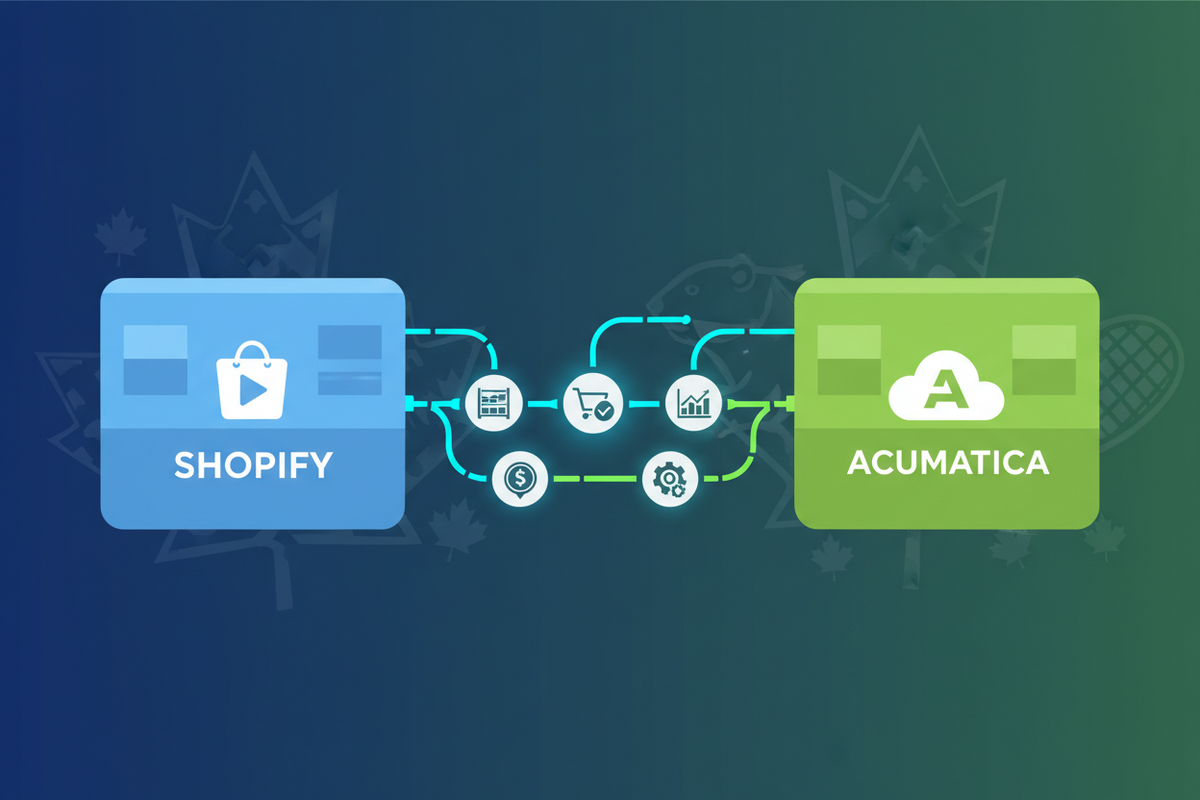
When a merchant evaluates Acumatica, the question always comes back to: what difference will it make for my team day-to-day?
That's the right question. ERP demos are often impressive. Well-designed screens, moving graphs, filled dashboards. But what really matters is elsewhere. It's in the time the team stops losing, in the errors that stop being costly, and in the numbers that finally match up.
Here's what truly changes when Shopify and Acumatica finally speak the same language.
Manual Entry Disappears
Today, in most Quebec SMEs, here's the typical sequence. An order comes in on Shopify. Someone sees it, verifies payment, opens QuickBooks or another system, re-enters the customer, re-enters the products, adjusts taxes, updates an inventory file elsewhere, prepares shipping.
With true integration, this same order appears in Acumatica in a few seconds. The right customer, the right products, the right taxes according to the delivery province, adjusted inventory. No one touched the keyboard.
For 50 orders a day, that frees up 15 to 25 hours per week. For 300, it's a full-time position that starts doing something more useful.
A Single Number for Inventory
The classic scenario: QuickBooks says there are 12 units left. The warehouse's Excel file counts 8. Shopify displays 15 because the last update was on Tuesday. Someone orders a product we no longer have. We refund, apologize, and the customer doesn't return.
With real-time integration, there's only one number. Inventory lives in Acumatica and syncs with Shopify in both directions. Sales, returns, transfers between warehouses, supplier receipts – everything is reflected instantly. If you have two or three warehouses, Acumatica manages inventory by location and automatically allocates the order to the most logical warehouse.
The benefit is operational, but also financial. You stop overstocking for safety. You reduce urgent orders from suppliers. Capital that was tied up in excess inventory is freed up.
B2B and B2C in the Same Store
Many Quebec merchants sell to both consumers and businesses. On Shopify alone, managing B2B with its negotiated prices, payment terms, and customer portals is a headache. Either you build a separate B2B store, or you tinker with promo codes and customer tags that end up contradicting each other.
With Acumatica connected to Shopify, negotiated prices come directly from the ERP. A B2B customer logs into the store and sees their prices, credit limits, and terms. B2B orders follow a different approval flow than B2C. Invoices are generated in Acumatica with the correct payment terms. Everything stays within a single Shopify platform.
Reports Stop Lying
This is probably the most underestimated change. When all data comes from the same system, the numbers finally align.
Gross margin by category. Profitability by channel. Customer acquisition cost versus lifetime value. Performance by store or branch. All of this becomes accessible in a few clicks, without exporting Excel files or cross-referencing tabs.
A manager wondering on Monday morning if a certain product line is worth keeping gets their answer in five minutes. Not at the end of the month. Not after a meeting with the accountant. Immediately.
This change transforms the decision-making culture. Instead of discussing by instinct, we discuss numbers. Instead of planning by gut feeling, we plan based on real trends.
Return on Investment, in Concrete Terms
A well-executed Shopify-Acumatica integration project generally pays for itself within 12 to 24 months. The sources of savings are quite predictable.
First, time. For an SME processing 100 orders a day, we're easily talking about 30 to 50 hours per week recovered across accounting, inventory, and customer service. Then, the reduction in errors: incorrectly entered orders, duplicate refunds, stockouts leading to lost sales. Next, inventory optimization, where a 15 to 25% reduction in excess stock is typical. And finally, decision speed, harder to quantify but very real when you stop navigating blindly.
The cost of an ERP project is not negligible. But compared to the hidden cost of current inefficiency, calculated over three to five years, the calculation almost always leans towards the investment.
What Separates a Good Project from a Bad One
Shopify-Acumatica integration is not a product you install. It's a project that requires understanding your specific flows, pricing rules, inventory logic, and exceptions. This is exactly where the implementation partner makes all the difference.
A partner who only knows the ERP delivers a generic integration. It works in a demo, but it breaks down in real cases. A partner who only knows Shopify underestimates accounting complexity and creates reconciliation problems that take months to untangle. The right partner works both sides in parallel and anticipates pitfalls before they arise.
This is Agence Mindweb Inc.'s niche. As a member of Acumatica's Alliance program and an experienced Shopify partner, we design integration by thinking about both worlds simultaneously. We document your current flows, identify friction points, and build an integration layer that holds up at high volume and evolves with your business.
A Concrete Example: the Abris Tempo Group
Abris Tempo, owner of the Navigloo and Tempo Tents brands, has been operating on Acumatica for several years to manage its operations across its different product lines. When it came time to expand online presence and connect Shopify stores to the ERP, Mindweb designed and built the integration for all three brands. The result: a single source of truth for inventory, orders automatically flowing from Shopify to Acumatica, and teams that stopped juggling multiple systems. See the Abris Tempo project →
Partager:
Shopify & ERP in Canada: When to Switch from QuickBooks to Acumatica
When does an SME in Quebec need a real ERP system?